
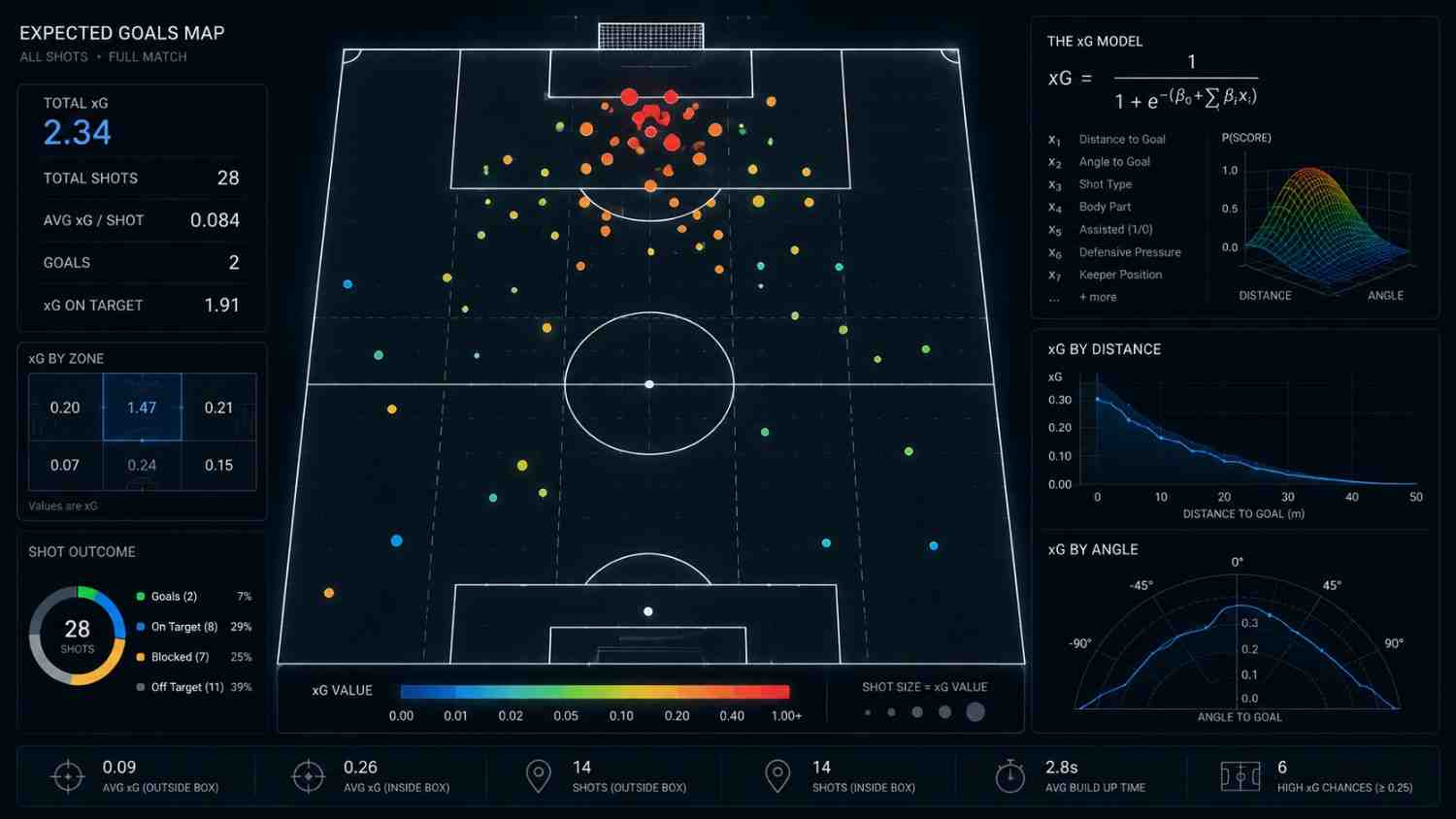
Before the 2010s, analysis of betting on football relied on player form, previous encounters between the two teams, and betting predilection developed from viewed matches. Now, the same analysis relies on one key performance indicator: expected goals (xG). Initially, expected goals were a measure of interest for data scientists at conferences. xG began to find its way to analysis software, then betting tipster blogs, and now finds its way directly to players from betting companies (operators). The metric has not eliminated other forms of analysis; it has become the dominant way of looking at everything else.
What xG actually measures
Expected goals is a probability-weighted estimate of how many goals a team should have scored given the chances it created. Each shot generates a number between zero and one based on where it was taken from, the type of attempt, and what happened just before it. The metric matters for tipsters because it separates signal from variance — a team that lost 2-0 but generated 2.4 xG against 0.6 was probably the better side that day, even if the scoreline disagrees. Mobile bettors who want xG without leaving the app rely on operator-side analytics; pulling 1xBet Somalia free download apk for in-app match data lets a punter see xG, possession share, and shot quality alongside live odds without flipping between browser tabs.
A goal from 6 yards out is about 0.7 xG, while a shot from 30 yards out is about 0.03 xG. Over the course of a full 90 minutes, the sum of shot xGs shows what should have happened, even if it differs from the actual final score. Most of the time, the gap between what actually happened and what is expected is where the most variance occurs, and is what the tipster should be most focused on rather than the final score, as there is most of the time a significant gap.
Why xG outperforms intuition over a season
Football is extremely unpredictable. A season is only 38 games long, and the outcomes of single games can even be impacted by random things like a deflection, keeper make a great save, or an offside call. Final score focused tipsters will end up relying on the most unpredictable part of the game, which is the final score. On the other hand, looking at xG from recent games will help tipsters make a more informed guess.
The signals serious tipsters now combine with xG include:
– Expected goals against (xGA) for assessing defensive workload
– Non-penalty xG to eliminate the variance introduced by penalty kicks
– xG per shot to assess the quality of a scoring opportunity independently from the quantity of scoring opportunities
– Rolling ten-match averages instead of season-long averages
– Home and away splits for venue-dependent teams
Where xG falls short
xG has its limitations. The model assumes a typical finisher rather than differentiated shooting quality. For example, a striker with a shooting conversion rate of 25% better than average will outperform his xG over the long run, and that is a valid result, not an xG noise. Modeling the variance of set-piece scoring opportunities for open-play scoring opportunities is typically more challenging. Red cards, weather, clashes of local rivals, and even the appointment of a new manager all have an effect on the processes xG attempts to capture.
The Premier League statistics centre recently began to publish xG for every match and every team, and the use of this metric has become uniform across multiple lines of football. The widespread use of the metric has also impacted the gambling world given that xG is something bettors can enjoy without relying on third-party data providers.
Why analytical edge alone does not pay
Even those who integrate xG into tips tend to lose money. xG sharpens your eye to when a market opportunity is genuinely mispriced. Yet, it does nothing to help a better value bet stake, a better bet worth the time to place, or a more valuable opportunity. The Bookmaker’s Edge is the difference between tipsters. Even a tipster who places each wager as a positioned stake in a long-run wages a better cause than a loose stake tipster.
Seconds help tipsters control edge wastage. Tipsters can set their stake to a percentage of their total bankroll, and set a fixed number of leagues, and minutes. Football betting works as a fun hobby, but not a source to earn. Without that note, even the xG tipster will see their losses stack up.