
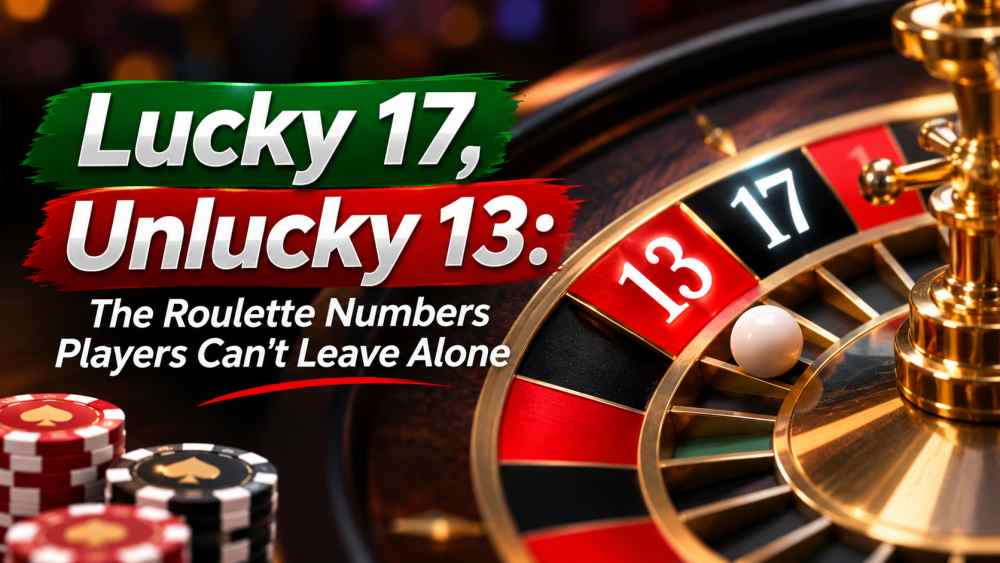
Halloween is approaching, and Friday, November 13th, 2026, is coming soon after. It’s a busy few weeks for black cats, bad omens, and anyone who would rather skip the number 13 altogether. At a roulette table, though, that supposedly unlucky number has exactly the same chance as every other pocket.
Then there’s 17. Ask a few roulette players which number they’d back, and 17 is likely to come up. It’s easy to spot near the middle of the table, and James Bond choosing it further boosted its reputation.
But how much of that fame holds up? And what about zero, the green pocket players sometimes cover “just in case”? The answers tell us quite a lot about how people choose their bets. The wheel’s math is much simpler.
Is 17 Really Roulette’s Most Played Number?
Seventeen is often called the most popular roulette number. Still, many players would rather bet on their birthday, an anniversary, or a number that has won for them before. So, it’s fair to say 17 is a widely recognized favorite rather than a proven global champion.
Its Position Helps It Get Noticed
Whether you play roulette online or at a casino table, you’ll find 17 in the middle column, near the center of the standard betting grid. It’s easy to spot when you look down at the table. The grid has 12 rows, so the halfway point falls between the rows containing 16-18 and 19-21. If you haven’t arrived with a number in mind, it’s an easy one to spot and choose.
That position only helps it attract attention. The numbers run in order across the betting grid, but they follow a different sequence around the wheel.
Think of it as a good seat at a party: easier to get noticed, without any special privileges.
James Bond Gave Black 17 Lasting Fame
If you’ve ever wanted to borrow a little of James Bond’s casino confidence, black 17 is a familiar place to start. Sean Connery’s 007 backs it in Diamonds Are Forever (1971), giving the number a film credit most roulette pockets can only dream of.
You can borrow his choice, though the tuxedo is optional and the odds stay the same.
That makes 17 memorable. A number connected with a famous character has something that, say, 22 usually doesn’t. However, a movie scene can only give you a preference. It can’t prove the number wins more often.
A Little Bond Flair for Your Next Bet
You don’t need a secret mission to borrow Bond’s choice at the roulette table. Black 17 gives film fans a small nod to Diamonds Are Forever, and it’s easy to find near the center of the betting layout.
A single chip on 17 is a straight-up bet: you’re backing that number alone. Under standard rules, a winning $1 bet pays $35 in profit, with your original $1 returned too. It has the same 1 in 37 chance as any other number on a single zero wheel, but you can still enjoy having a favorite with a famous film connection.
Why 13 Gets Such Mixed Reactions
Thirteen arrives at the table with its own reputation. Its association with bad luck is familiar in Western culture, though the origins of the Friday the 13th superstition are hard to pin down.
At roulette, that reputation can encourage opposite choices. A superstitious player might avoid 13. Someone else might deliberately choose it, enjoying the idea of backing the number everyone is supposed to fear. Neither choice changes its chance of winning.
There’s also no reward for being contrary. Roulette payouts don’t rise because fewer people backed your number. Under standard rules, a winning straight-up bet pays the same whether you chose a favorite or a number nobody else would touch.
The best strategy is to enjoy Halloween without treating the calendar as betting advice.
What’s the Deal with Zero?
Zero is green and separate from the red and black numbers. It also falls outside the standard red/black, odd/even, and high/low betting groups. Most casinos don’t count zero towards an odd or even bet. That encourages some players to put a separate chip on it while making other bets.
Say you wager $5 on red and $1 on zero. Under standard rules:
- If red wins, the red bet earns $5 profit, while the zero bet loses $1: $4 profit overall.
- If zero wins, the $1 straight-up bet earns $35 profit, while red loses $5, for $30 profit overall.
- If black wins, both bets lose: $6 lost overall.
Covering zero changes the possible results and increases the total stake. It doesn’t remove the house edge.
Some tables have special zero rules or use double zeros, like American roulette.
Every Number Still Has a 1 in 37 Chance
A single zero wheel contains 37 pockets: numbers 1 to 36, plus zero. On a fair wheel, each has the same chance on every spin: 1/37, or 2.7%, to win.
That applies equally to 17, 13, zero, and every other number.
Standard straight-up bets pay 35 to 1. A winning $1 bet therefore earns $35 profit and returns the original $1 stake, for a total of $36.
Imagine 37 separate $1 bets on 17, with exactly one win. You would spend $37 and receive $36, finishing $1 down. Actual results won’t follow that neat pattern, but it illustrates what a 2.70% house edge actually means.
Also, “1 in 37” doesn’t mean a number must appear once every 37 spins. Seventeen can repeat or remain absent for much longer. Previous spins don’t make it due.
Pick a Favorite Without Giving It Special Powers
Players often have a favorite number. Seventeen has the Bond connection, 13 has its seasonal appeal, and zero offers a distinctive green target.
Remember, having a favorite doesn’t give it a better chance of winning. A familiar number, a famous headline, or Friday the 13th can explain your choice. None changes the probability of the next spin.
In order to enjoy the game, the best strategy is to set a spending limit, take breaks, and keep your bankroll steady.