
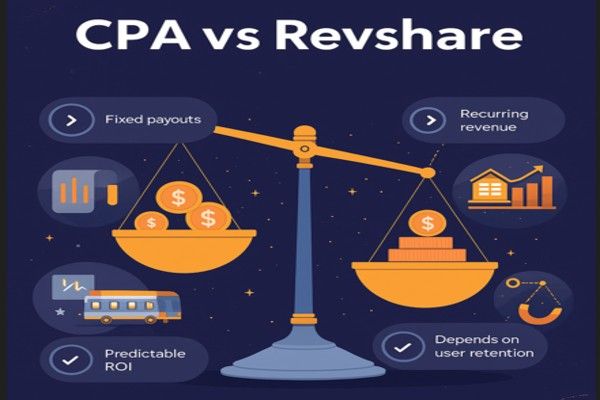
Affiliate marketing is no different and the commission model you choose can mean a lot of difference in the amount of money you make. One of each of these most popular models is Cost Per Action or CPA and Revenue Share or Revshare. CPA can provide a predetermined amount of payment per individual action of the referred user, to which a set payout can be achieved, such as a sale or lead creation. Revshare, however, offers a minimal percentage of revenues that affiliates generate as long as the customers they refer continue to spend money, and this can in many instances generate a nice source of passive income in the long run. However, which is the one which pays most at the end of the day? This is not a simple answer, it depends on your area of expertise (niche), how do you draw traffic, the product you sell and long term strategy of you. This article dissects the differences, advantages, disadvantages and the must knows to help you make your decision. To immerse in Revshare vs CPA, visit the following meticulous comparison.
Understanding CPA: Fixed Payouts for Immediate Results
CPA/ Cost Per Action is a payment model in which the affiliates receive a fixed rate of money per qualifying action. This may be a sale (what is commonly referred to as Cost Per Sale or CPS), a lead (CPL) or even an app install (CPI). As an example, suppose you want to advertise a health supplement, in which case you can get a commission of $30 per bottle clicked through your referral, irrespective of the total value of the order.
Pros of CPA for Affiliates
- Fast and Forecastable Profits Payments are instant when the action is completed, allowing to more easily predict income and reinvest into campaigns.
- Reduced Risk of returns: affiliates do not get partially refunded or chargeback; the cost is taken by the vendor.
- Scalability using Paid Traffic: It is good for running high-volume campaigns involving advertising because the fixed commissions make ROI calculations easy.
Cons of CPA
- One Time Payments: You receive money only once per each activity and a chance to continue getting revenue couldn t be accessed.
- Capped Upside on highest value Sale: Income does not increase with bigger sale or upsells.
- High Traffic: Needs a significant portion of lasting traffic to serve a stable income which might be fluctuating in case of permanent bans on ads or offer switching.
On niche sites such as credit score offers, affiliates have of working, earning $300 a day with CPA payouts of $25 per lead; however they do not have a steady flow of income.
Understanding Revshare: Percentage-Based for Long-Term Potential
Revshare is where you receive a proportion of the revenue made by referred customers- usually 1%-75 and even greater. This model glitters with products that are on recurring billing such as SaaS tools or subscriptions. By way of example, selling a $49/month software that has a 30 percent cut would result in an earning of 15 dollars per user per month, which could add up to a total of 1,500 in case of 100 subscribers. Affiliate programs such as Betboom affiliate incorporate revshare payment structures where affiliates are incentivized on program longevity when it comes to customer retention in the igaming sector.
Pros of Revshare for Affiliates
- Passive Income Opportunities: Income does not stop coming in as long your customers are purchasing, as long term relationships are rewarded.
- Increased Potential on Upsell and Recurring Revenue: There is potential to earn higher commissions on upsells, and on recurring revenue, when high value orders are made, e.g. $113.25 on a $151 order at a 75% share compared to $60 on a $151 order.
- Uncapped Earning Cap: For example, in a high customer lifetime values business such as gambling or forex the revshare revenues can result in very large recurring earnings.
Cons of Revshare
- Slow payment: Earnings accumulate gradually and thus it needs patience and may require cash flows.
- Shared risk on returns: Part of the returns in terms of refunds and chargeback are borne by the affiliates, thus decreasing net earnings.
- Loyalty to Clientel: When users churn fast, profits die off; business prosperity relies on the product quality and its lifetime monetary worth
Online business tools affiliates have used their SEO and YouTube in building incomes of revshare of $3,000/ month, and revshares of old materials remain an earnable income.
Key Factors to Consider: Which Model Pays More?
Determining which model yields higher payouts depends on several variables:
| Factor | Favors CPA When… | Favors Revshare When… |
| Traffic Source | Using paid ads for quick, high-volume leads | Building organic, engaged audiences (e.g., blogs, email lists) for loyalty |
| Product Type | One-time purchases or low-value items | Recurring subscriptions or high-lifetime-value products like SaaS or igaming |
| Time Horizon | Needing immediate cash flow to cover costs | Willing to invest in long-term passive income |
| Risk Tolerance | Preferring predictable, fixed earnings | Accepting variability for higher upside potential |
| Niche and Scale | Testing multiple offers rapidly | Focusing on niches with strong retention, like forex or gambling |
In short-term campaigns, CPA tends to deliver higher initial costs, but high payouts to actions such as downloading an app or signing up. But in the longer term, revshare is often the better deal, especially when customer lifetime value is higher than the starting CPA payout – as is often the case with evergreen content that pays out consistently at a rate of $7,000 a month, in contrast to the unstable income of ads at a rate of $1500 a month. In igaming, revshare commissions stay in percentages of gross revenue, whereas CPA could be of 506250 per depositing player but with active users revshare cuts much more.
Hybrid Models: The Best of Both Worlds?
Most programs have become a hybrid payment structure such as a onetime CPA with recurring revshare. One example is a first sale of $10 CPA and a 5 % repeat sale. This inspires fast conversions and residual income at the same time Hybrids are common in forex where parts have less interest rate value but they have balanced returns when combined. Newcomers may want to use CPA as an entry point to generate profits quickly and then switch to hybrids or revshare once they are ready to scale up. To find out about affiliate programs dedicated to different markets.
Conclusion: It Depends on Your Strategy
After all, neither CPA nor revshare universally earn more- CPA tends to work best in competitive markets which scale well, revmat makes sense in markets with higher retention, where the shift toward passive income is easier. Evaluate the situation: How much traffic do you have; in what niche does it fit; and what are your objectives? Test both, measure such things as customer lifetime value and look into hybrids to have flexibility. Maximizing your affiliate income as a sustained success is possible when you use the model to align with your strengths.