
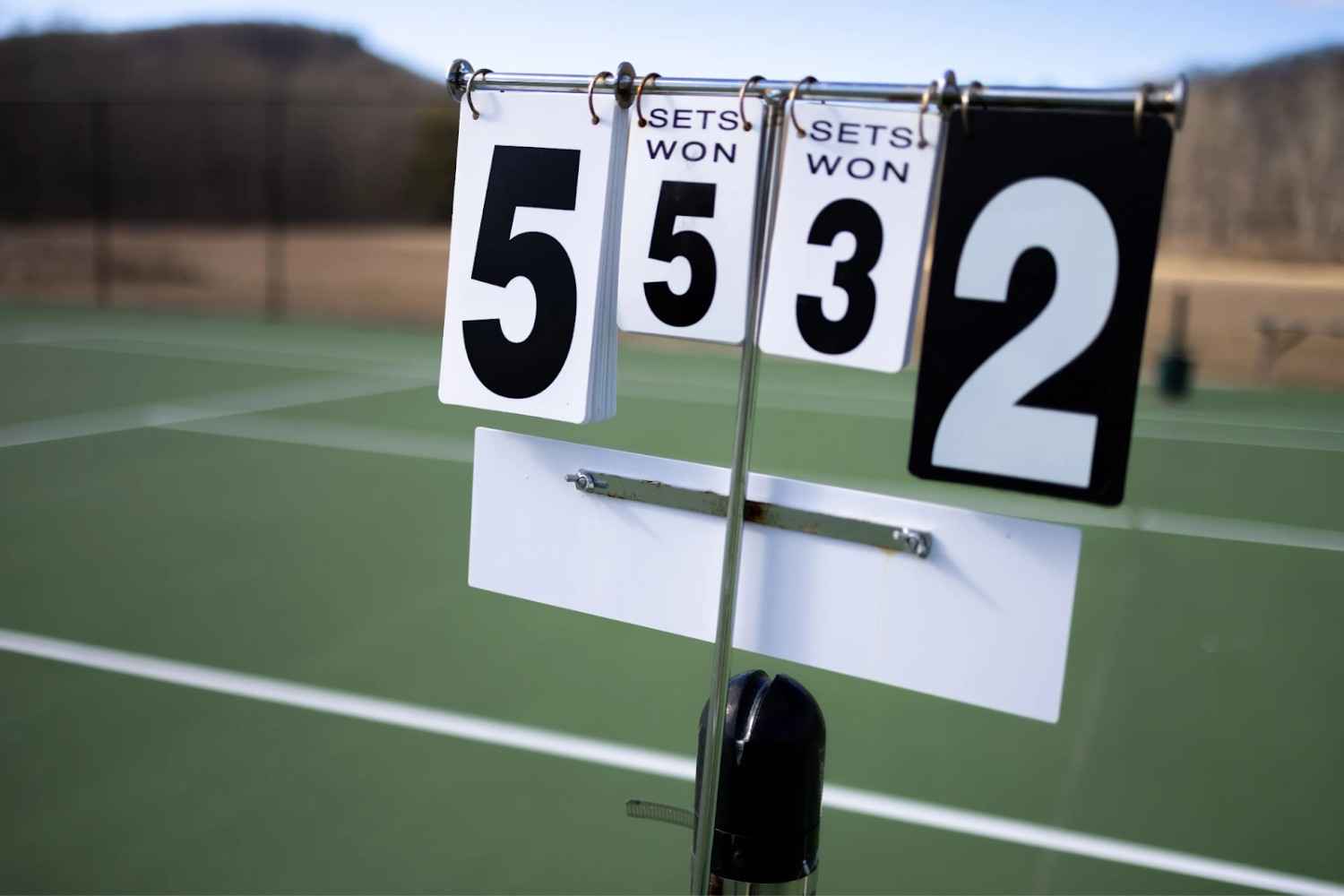
How Many Sets Are There in Tennis? Understanding the Game’s Hidden Logic
In professional tennis, the number of sets in a match not only impacts the rhythm, tension, and ultimate drama of a match, but also shapes each of these elements in profound ways. Spectators may ask how many sets tennis has, but the ardent follower is trying to understand how the scoring is constructed to transform the match from a rout to a nail-biting thriller, or vice versa.
Set formats in tennis become critical in the statistical and analytical betting context, which is often clouded by the high-paced live betting. For real-time score updates, betting odds, and match metrics, fans can access the official BetFM casino, which also contains comprehensive tennis analytics. This is perhaps the best analytic way to enjoy the sport and understand how the number of sets in a match affects the final score.
In tennis, a set is not merely a technical unit. It also encapsulates what has to be the most fundamental, yet often most overlooked aspects of the sport, which is, resistance and control. From the local court to the grandest of stages, Wimbledon and Roland Garros, it is the sets which formalise the rhythm of each rally, every serve, and score.
What a Set Really Is
To really understand a set in tennis, we need to strip it to its most fundamental components. One tennis match can be thought of as a ladder, where points build into games, games into sets, and sets into a match victory. A player needs to win a game by winning four points. To win a set, you need to win at least six games and be ahead by two. To win a match you need to win a certain number of sets, which can differ. Simple enough, but not quite easy if you really think about it.
The fact that there are recessions and resets within the game, working the layered to build and win a match, is what separates tennis from most other sports. That is the unique characteristic of the game. Losing a point, winning a game, losing a game, and winning the entire set. The entire sport is set up on the concept of second chances.
The scoring system can be broken down in the following ways:
| Stage | What It Means | How to Win |
| Point | The smallest unit | Reach four points with two-point lead |
| Game | A group of points | Win six games, lead by two |
| Set | A group of games | Win six games, or win a tiebreak at 6–6 |
| Match | A group of sets | Win 2 of 3 or 3 of 5 sets |
The system has its own unique rhythms. A set can be completed in 20 minutes or dragged out over the course of an hour. Players have the option to rewrite the outcome of the match, even if they lose the first set, which makes the focus on sets feel more like a mood shift as opposed to a simple statistic.
Best of Three and Best of Five — The Two Faces of Tennis
How many sets are there in tennis? The answer can largely depend on two formats that control everything: the best-of-three sets and the best-of-five.
Tournaments are predominantly played under a best-of-three system. Winning two sets means a player captures the match, ensuring the competition stays taut. Every minute, careless errors, especially during service breaks, can prove costly. Such a system aids player concentration, allowing the completion of a match within a two-hour frame, thus maintaining the attention of a viewing audience. This is how advanced tennis is envisioned: fast, aggressive, and relentless.
Still, the best-of-five system exists for the Grand Slam tournaments. The system is exclusive to the men’s singles and for good reason. It can stretch a player’s physical and mental endurance to the limit. Winning these matches means the player has to walk away with three sets, which can be done within a time frame of 4 to 5 grueling hours. It is during these sets where a player can make errors that get immortalized in the sport while stunning comebacks to secure a win are the stuff of legends.
Having time to win a match of this magnitude can test a player’s mental resolve. As Nadal once stated, it can be the key differentiator in any match: the legs, the mind, and the heart. The heart is often what allows a player to win a match after it has been mentally drained. The system then is a perfect balance of heart and skill, creating a match that isn’t just a burden, but a captivating spectacle.
With the changing formats in the game, the formats and their durations are:
| Format | Needed to Win | Used In | Average Duration |
| Best-of-Three | Two sets | ATP & WTA tours, Olympics, doubles | 1.5–2 hours |
| Best-of-Five | Three sets | Men’s singles at Grand Slams | 3–5 hours |
Two structures, two worlds. One shaped by television and time; the other by history and stubborn tradition.
Why Tennis Keeps Two Systems
If the sport already works, why keep both? The answer is part history, part biology, and part business.
When organized tennis was born in the nineteenth century, there were no fixed formats. Matches could stretch into absurd lengths. By the early 1900s, officials decided to limit chaos and standardize competition. Men, influenced by the era’s ideals of stamina, played longer. Women’s events adopted three sets, emphasizing speed and precision.
Then came television. Broadcasters couldn’t predict a match that might last six hours, so the three-set format became the default. It fit programming schedules, player recovery, and the global calendar. The five-set match, however, survived as a symbol. It was too iconic to kill — the arena of heroes, where great rivalries found their full story arc.
As Craig Tiley, the head of Tennis Australia, once explained to The Times: “The five-set match is where the sport shows its soul. It’s hard, sometimes too hard — and that’s exactly why we keep it.”
Presently, the two formats are coexisting out of necessity. The shorter version keeps the sport fast and accessible, while the longer version keeps it noble. Together, they tell the same truth: tennis is a test of precision and, more critically, persistence. One set may build tension, but it’s the number of sets that builds legend.
The Modern Game – New Formats and Fresh Experiments
Tennis keeps its traditions but continues to adapt. Matches that once stretched endlessly now fit, if not perfectly, into a faster, more digital world. The rise of streaming, short-form highlights, and tighter schedules has made it so that organizers need to revise the game’s old formats, without breaking its logic.
One notable adjustment is the super tiebreak, which substitutes the final set of most doubles matches. Instead of playing another full set, teams play to ten points. This not only abridges the game but keeps the pressure intact. The Fast4 format also aims to hasten the game by shrinking sets to four games and replacing the long deuces with sudden death points. At the NextGen ATP Finals, the rules are even stricter: players serve within twenty-five seconds, and coaching is permitted from the stands through headsets.
Such attempts at innovation tend to attract opposing views. The older crowd tends to appreciate the longer version of the game, while the younger audience is more focused on the pace and clearness of the game. However, the objective, and the most important, still remains the same: competitiveness and watchability. The introduction of shorter formats does not aim to simplify the game; rather, it aims to strip the sport down to its most basic elements and show just how flexible its structure really is.
Five Modern Variations Every Tennis Fan Should Know
Super Tiebreaks – In doubles, the deciding set is replaced by a race to ten points.
Fast4 Tennis – Sets are limited to four games with no advantage scoring.
Next Gen Format – For rising players, there are timed serves, short sets, and live coaching.
Team Events – Laver Cup and similar competitions combine singles and doubles with altered scoring.
Exhibition Matches – Informal games are often played as one long set for simplicity.
The essence of tennis has not changed despite constant revisions over the years. What shifts may be in the scoring systems, but at the end of the day, it is the skill, the pressure, and the nerves in contest that are unyieldingly the same.
Legacy and Drama – When Sets Become Stories
Tennis is special in that every individual set told a story. Each contained their own tension, reversals, and a distinct set of emotions. For instance, some matches are memorable not because of the victor, but because of how the individual sets told their own unique saga. Under the setting sun of Wimbledon 2008, more than five hours was spent on a classic exchange of dominance between Rafael Nadal and Roger Federer, each set and each game intimately contested. Every set was a legendary battle: one on grass, the other in dimming light, and the last in history.
The 2022 Australian Open final epitomized this. Nadal stunned the world when he recovered from two sets down against Daniil Medvedev to capture the title in five sets. People remember more than the final score. The high, the low, and the remarkable climb after a crash is what made the sets memorable.
“Tennis doesn’t really have quarters or halves. It has stories—and every set is one of them.” McEnroe said this as Davis Cup captain and ESPN commentator.
And that’s why the length of sets will always remain unchanged. Sets may be one of the elements allowing the sport to deeply intertw tragedy and joy, but they also provide a constant rhythm.
Conclusion – The Meaning of Sets
To ask how many set does tennis have is to ask how long a story should be told. Some stories are quick, others are epic. Tennis is a succession of markedly different tales, and that is why it endures. The number of sets—two out of three, or three out of five—isn’t just a rule. It’s a way of defining character.
With the best-of-three, it is possible to create a feeling of modern pace and surprising speed. The best-of-five, however, sows the soul of the game, showing that true endurance still exists. Together, they explain why tennis endures: the struggle, the poise, and the patience to win one set at a time.
FAQ
1. Why are men’s and women’s formats different?
This is due to the scheduling traditions of the sport that started in the early 20th century, not because of biology. Today it mostly has to do with audience time and still has traditions of inequality in the sport.
2. What is the set structure in junior or amateur tennis?
Most amateur matches are still played in the best-of-three set format. However, in some leagues, for the sake of time, they will simplify it to one long set of 8 games.
3. Can you complete a tennis match in just 2 sets?
Yes. In best of three format, a straight-sets win of 2–0 will end the match, showing that the opponent doesn’t have enough skill to win a single set.
4. Why do Men’s Grand Slams still keep best-of-five?
It is primarily viewed that it is the ultimate test of a player’s skill, stamina, and endurance. It is also a part of the sport’s identity and the traditions that date back over a century.
5. How long can a five set match go on for?
There is no specific answer to this question. There are some, like the 2010 Isner–Mahut match at Wimbledon, that have actually exceeded eleven hours. However, to avoid this, rule changes have been made to include tiebreaks.
6. Are tiebreaks present in every set?
Most sets will have a tiebreak at 6–6, but in some older Grand Slams, the final sets just had to be won by 2 clear games. For fairness, all the majors have made it a rule to include tiebreaks.